
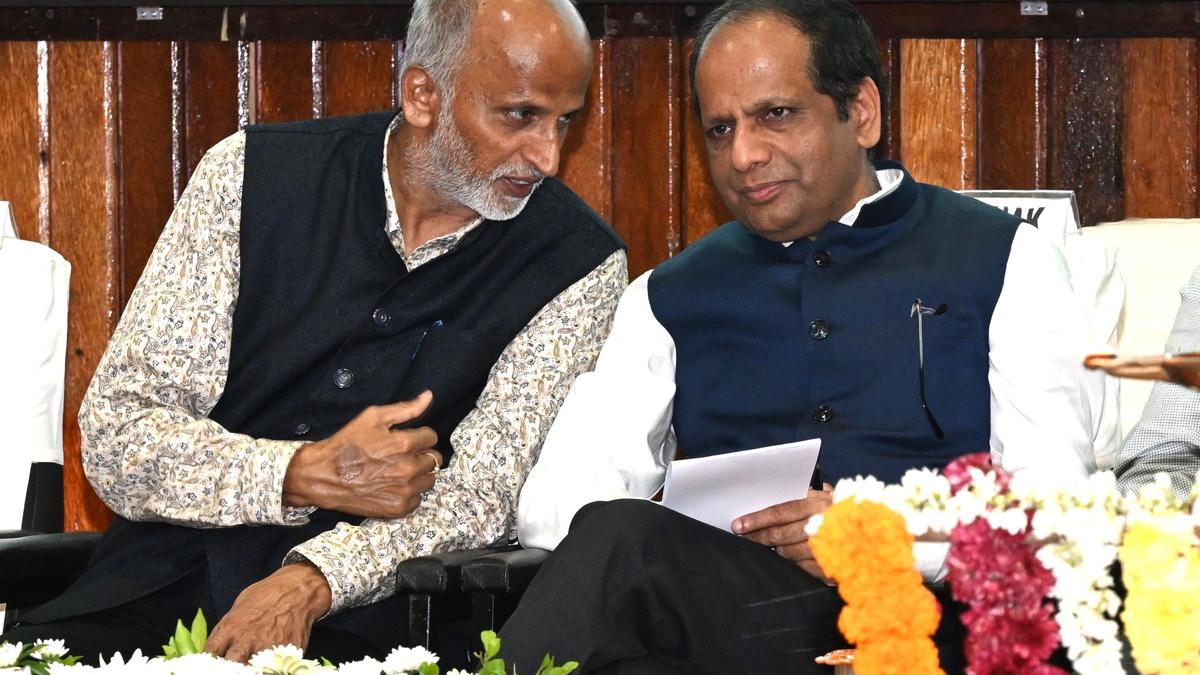
Himanshu Pathak, Director-General of Indian Council of Agricultural Research and Secretary, Department of Agricultural Research and Education, and K. B. Hebbar, Director of Central Plantation Crops Research Institute, Kasaragod, at Kasaragod on Friday.
| Photo Credit: H.S. MANJUNATH
The Indian Council of Agricultural Research (ICAR) has requested its scientists to ensure that new crop varieties were at least climate resilient.
“Climate change is a very big issue. So we have requested our scientists that whatever variety or technology they develop there must be at least one component of climate resilience. The variety should be abiotic stress tolerant and also biotic stress tolerant,” Director-General of Indian Council of Agricultural Research (ICAR) and Secretary, Department of Agricultural Research and Education, Himanshu Pathak, said on Friday.
Speaking to The Hindu on the sidelines of a three-day farm sector exhibition and seminar on ‘harnessing plantation sector for sustainable development goals’ organised by the Central Plantation Crops Research Institute (CPCRI) at Kasaragod, Mr. Pathak said that every variety cannot be tolerant to all kinds of biotic stresses.
“We have requested them (scientists) that new varieties must have at least one trait which will address climate change issues,” he said.
“More than 85% of our (ICAR) varieties released by Prime Minister Narendra Modi last year were climate-resilient varieties,” he said.
He said that notwithstanding climate change issues affecting the farm sector, the foodgrain and horticulture production had not gone down in the country for the past eight to 10 years.
“We are still producing a record. It is not that climate has become friendly. Climate is no more friendly and it will never be friendly. But total production is still increasing,” he said.
Mr. Pathak said wheat production did not go down despite terminal heat during March and April for the past four years in the country. “Because now over 70% of the area under wheat has climate-resilient varieties,” he said.
But he said there is always a limit. If the temperature went up beyond the expected level, “we need different kinds of technologies.”
He said that the ICAR has released 171 bio-fortified varieties of different crops in the last three years. They contained more protein, minerals, and vitamins.
For example, the Director-General said the common rice varieties have about 6% to 7% protein. “But now we have released rice varieties which have got more than 10% protein. We are requesting the government to promote such varieties through mid-day meal and such schemes. We are also promoting them among farmers.”
He said that the ICAR is also working on how to make soil fertility more carbon positive.
Published – January 03, 2025 09:27 pm IST


