
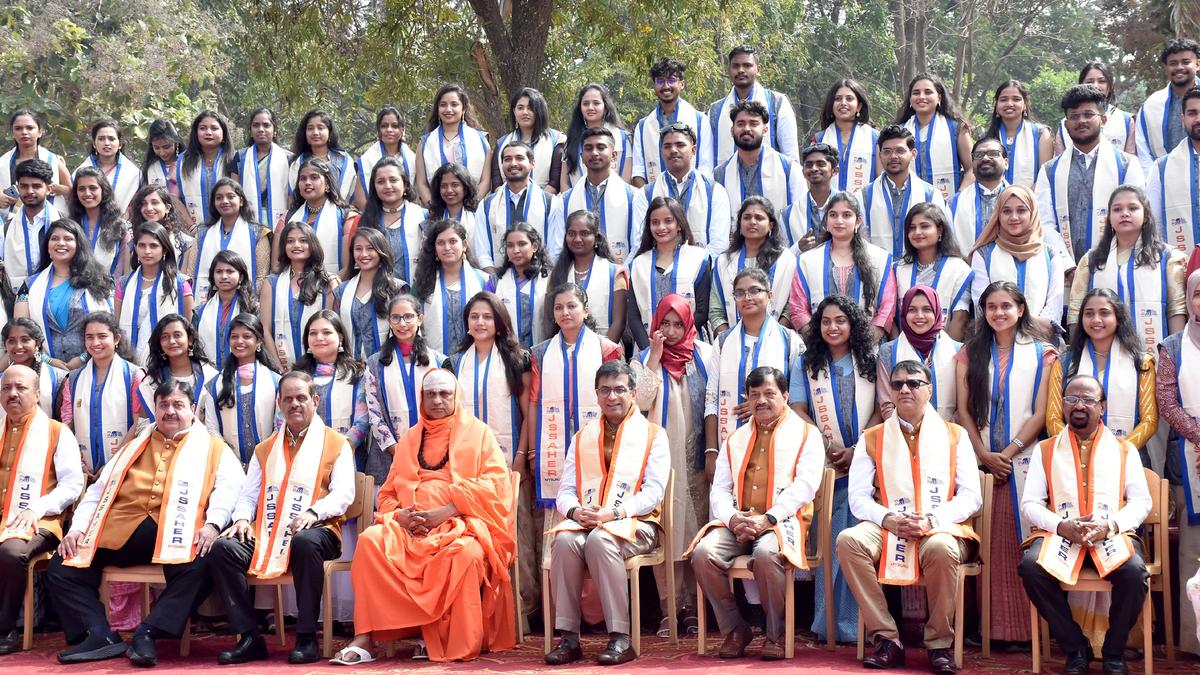
Former Chief Justice of India, D.Y.Chandrachud, Suttur Mutt seer Shivaratri Deshikendra Swami and others with a section of medal winners and toppers during the 15th convocation of JSS AHER in Mysuru on Friday.
| Photo Credit: M.A. SRIRAM
The 15th convocation of JSS Academy of Higher Education and Research (JSS AHER) was held here on Friday and former Chief Justice of India, D.Y.Chandrachud, who delivered the convocation address underlined the importance of sustainable development, accessibility, and empathy.
He said these three values shaped the world that we live in and were key to ensure that it led to a better tomorrow.
Dr. Chandrachud, said sustainable development at its core meant balancing the needs of the present without compromising the ability of the future generations to meet their own needs.
Addressing the passing-out graduates from various faculties, Dr. Chandrachud said in today’s inter-connected world it was not about merely preserving the environment but it was also about managing the impact one had on society, the economy, and the environment as a whole.
Congratulating the JSS AHER for its global recognition in the sustainable practices and development initiatives, Dr. Chandrachud said it was a wonderful achievement which was also a reflection of the values embedded in the fabric of the institution.
The former Chief Justice also touched upon access to healthcare and the need to make it more inclusive regardless of an individual’s background.
He referred to discrimination based on disabilities and citing a Supreme Court ruling — specific to medical entrance — said that disability did not disqualify someone from pursuing a medical course and becoming a medical practitioner.
Dr. Chandrachud said a medical practitioner was not defined by physical ability but by knowledge, compassion, and ability to serve others.
‘’By excluding such persons we lose our potentially brilliant doctors who bring new perspective to patient care based on their own experience,’, he added.
Speaking about the imperatives of equity in healthcare, Dr. Chandrachud said it was about making the system more responsive and inclusive so that individuals from challenging backgrounds too had access to healthcare.
In this context he said that at times both law and medicine had fallen short of fully upholding the ideals of accessibility due to deep rooted systemic challenges.
He highlighted the devastating consequences of inaccessibility that came to the fore during the COVID-19 and said high income countries with 20 per cent of global adult population, secured more than 50 per cent of the vaccine doses while lower middle-income countries with 37 per cent global population received only 12 per cent of the vaccine doses. This glaring disparity highlighted how inaccessibility could lead to unequal health outcomes and deepen existing global inequality.
The outgoing graduates were urged by Dr. Chandrachud to keep in mind the socio-econmic realities that shaped access to healthcare.
‘’The decisions you make will have a far-reaching effect on the communities you serve,’, he said, adding that while technical expertise was essential, empathy and understanding was just as crucial.
Dr. Chandrachud told the graduating students that they stood at the threshold of opportunity with skills that could transform lives and their education and skills was a tool and a responsibility to make lives better for others.
In all, 2,795 graduates were eligible to receive degrees from various branches while 104 scholars were awarded PhD.
In addition, 56 meritorious students received 75 medals and awards for outstanding academic performance.
Suttur Mutt seer Shivaratri Deshikendra Swami, C.G. Betsurmath, executive secretary, JSS Mahavidyapeetha, Basavanagowdappa, Vice-Chancellor, JSS AHER, were among those present.
Published – January 10, 2025 06:42 pm IST


