
Kocoatrait’s website does not earmark a page for sustainability. Not just one page, that is. Every page is punctuated generously with green terms. Green phraseology jumps out at the reader. Take these snippets. “Contributing to the circular and green economy”. “Plastic positive brand”. “Zero waste lifestyle”. “Kocoatrait addresses 12 out of the 17 Sustainable Development Goals.”
Every time the word Kocoatrait is breathed, another is proclaimed — “sustainable”. There is even an oxymoronic flavour to what this bean-to-bar brand offers — “sustainable luxury chocolates”. Reconciling sustainability with luxury takes some doing, doesn’t it?
All of this leads to one thing: round-eyed curiosity. And out pops the curious question: “What makes Gopalapuram-based Kocoatrait’s chocolates green?” And this question is shot at L. Nitin Chordia, co-founder of Kocoatrait. Nitin’s wife Poonam Chordia is the other co-founder.
Nitin remarks that sustainability begins at the very beginning: when the bar is just a bean.
But let us break the order, taking this story medias res, and not in its chronological progression.
So, the wrapper first, going against the grain of a philosophy that eschews judging things by their cover. But in the sustainability narrative, cover matters. Packaging matters. The Chordias pride themselves on striving at zero-waste packaging with minimal waste.
The company keeps the wrapper plastic and paper free by making it with upcycled cotton waste from garment factories and reclaimed cocoa bean shells — a byproduct lining the sidelines of the chocolate-making process. The wrappers are biodegradable, compostable and recyclable.
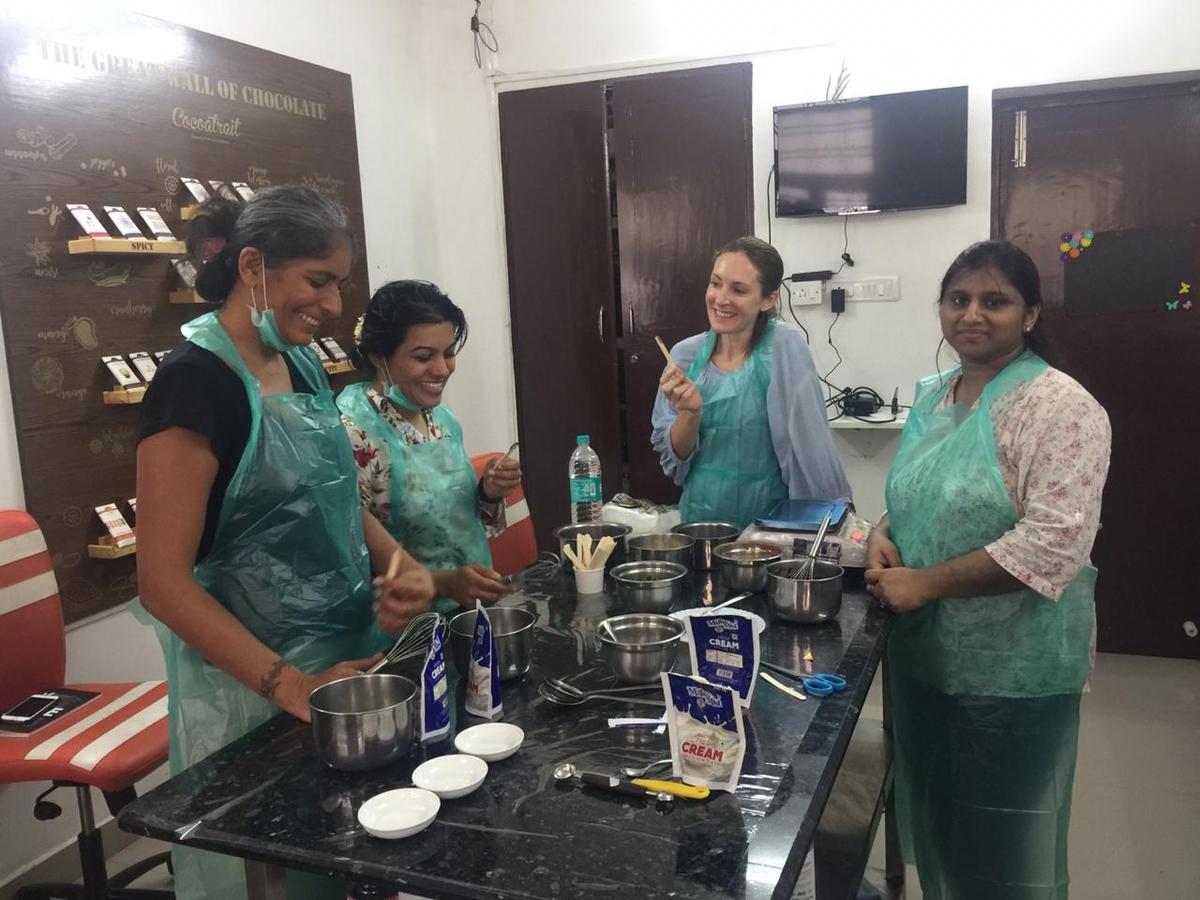
During a session at Cocoashala, a chocolate-making training academy being run alongside Kokoatrait at Gopalapuram, Chennai. Poonam Chordia is at the extreme right.
| Photo Credit:
Special Arrangement
And then, minimal packaging waste through size-optimised designs. “We do not believe in excess,” Nitin explains. “We are committed to packaging that fits the product perfectly, with no unnecessary waste.”
And according to the process notes (some of them in the public domain), “the chocolates are packaged in palm leaf boxes for gifting, and e-commerce boxes are designed for reusability”.
Before being placed in this wrapper, the chocolate bar is wrapped up in aluminium foil (recyclable and reusable) for protection and a card slipped in to elucidate the reader through a QR code on what to do with the aluminium foil.
Printing on the wrapper is done manually thereby saving electricity and with water-based inks. The artwork on the wrappers recommends them for being reused as bookmarks.
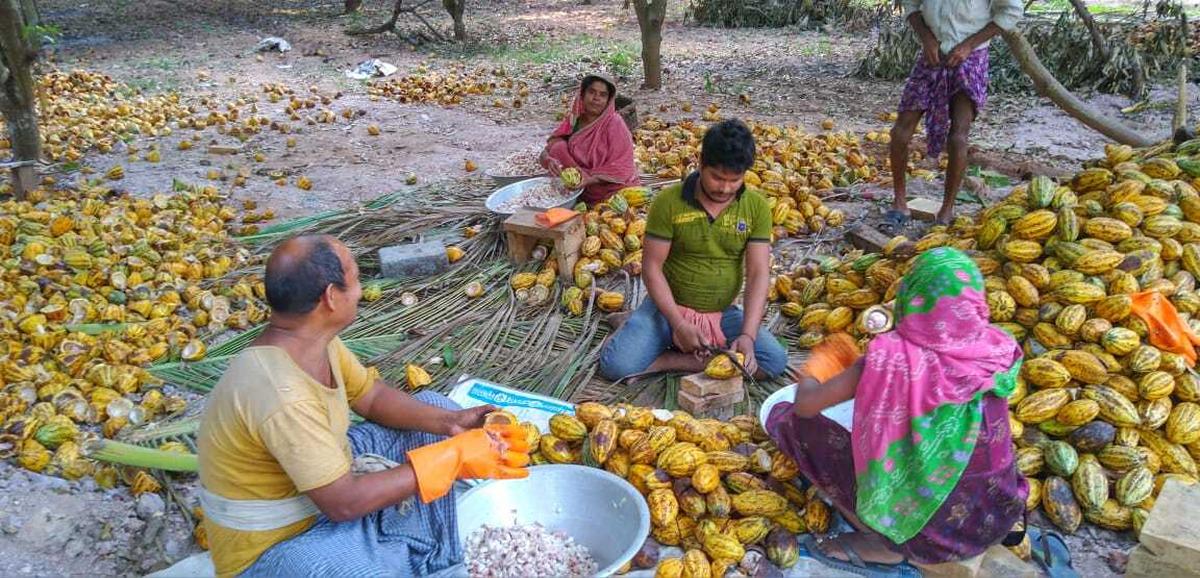
At a cocoa bean farm aligned with Kokoatrait.
| Photo Credit:
Special Arrangement
Nitin says he takes the idea of Extended Producer Responsibility (EPR) seriously, encouraging and even enabling consumers to return the wrappers for recycling.
These chocolate wrappers certainly lack gloss, thereby not drawing some pairs of eyes in a store crowded with chocolate-bar options. Nitin states he is not letting this bother him. “The focus is on sustainability and not aesthetics,” he affirms.
Inclusion is the other step in this sustainability journey, begins Nitin. The printing (with water-based ink) on the wrapper is carried out by 25 students at V-Excel Educational Trust (based at Thiruvengadam Street in Raja Annamalaipuram), which imparts skills to differently-abled individuals and finds them gainful work.
“This partnership is very close to my heart,” Nitin shares. “Not only does it align with our core values of social responsibility, but it also provides an opportunity to support a cause that truly matters.”
The farm stage
Traipsing to the beginning, where the bar is still a bean, one notices Kokoatrait knows its farmers.
Nitin points out how direct partnerships with cocoa bean farmers following organic and sustainable farming practices are forged, and a symbiotic relationship is started.
From Tamil Nadu, Kerala and Andhra Pradesh, a majority of these farmers have their farms within a 550 km radius from Chennai. Take the example of cocoa bean farm at Andhra Pradesh’s Eluru, around 512 km from Chennai.
By reducing the distance it takes for transportation of cocoa beans, the carbon footprint is reduced.
Nitin observes that these farmers tick boxes for not just sustainable as well as ethical boxes – there is no illegal deforestation for cacao farming and they do not employ child labour.
“It is a mutually beneficial relationship where farmers not only receive fair compensation but also gain access to resources, education and tools that enable them to build a more sustainable future for their communities,” says Nitin.
The production stage
Here are snippets from the production notes. “Energy-efficient electric air roasters replace LPG for roasting. In-house, energy-efficient cracking/winnowing equipment and traditional stone grinders enhance flavour while minimising contamination. Only essential imported equipment (melter, chiller, dehumidifier) are used for precision, with all-women production led by Poonam Chordia.”
A training academy
The years predating the launch of Kokoatrait were a time of focussed learning for the Chordias. Nitin would become India’s first certified chocolate taster in 2014. In 2016, Poonam and Nitin realised they could teach others how to make bean-to-bar chocolates, leading to the launch of Cocoashala, which after the birth of Kokoatrait, teaches chocolate-making with a stronger underpinning of eco-friendly processes.
Circling back to the question raised at the outset, how compatible are luxury and sustainability?
Nitin names what he thinks is (and should be) gaining ground globally — “eco-conscious luxury”. He essentially sees his company as being aligned with it. He acknowledges the high costs of sustainability but emphasises the importance of not compromising. “Yes, the cost is high, though it is expensive we cannot take a step back. Though there is an increase in cost and a decrease in profit, it is critical to give back.”
The green consciousness
2010: While in the United States, L. Nitin Chordia was exposed to discussions on environmental issues such as plastic pollution and ozone depletion, sparking self-reflection on how he can make a difference on the personal front
2018: A BBC article about a deep-sea diver finding a candy wrapper in the ocean served as a powerful image leading Nitin to ask deeper sustainability questions
2019: The Chordias – Nitin and his wife Poonam – launch a sustainable luxury chocolate brand in Amsterdam, embracing eco-friendly practices and redefining chocolate as a responsible indulgence
2020: Due to COVID-19. International export plans are stalled, prompting a pivot to the Indian market, where Nitin discovered a growing appreciation for sustainable products
2022: Google and Salesforce selected the Chordias’ chocolates as Diwali gifts, bringing new visibility and credibility to the brand
2023: Expanded into Indian retail, with products available in stores such as Reliance Fresh in Bangalore and Hyderabad, furthering efforts to make sustainable chocolate accessible across India
Published – November 15, 2024 09:48 pm IST


