
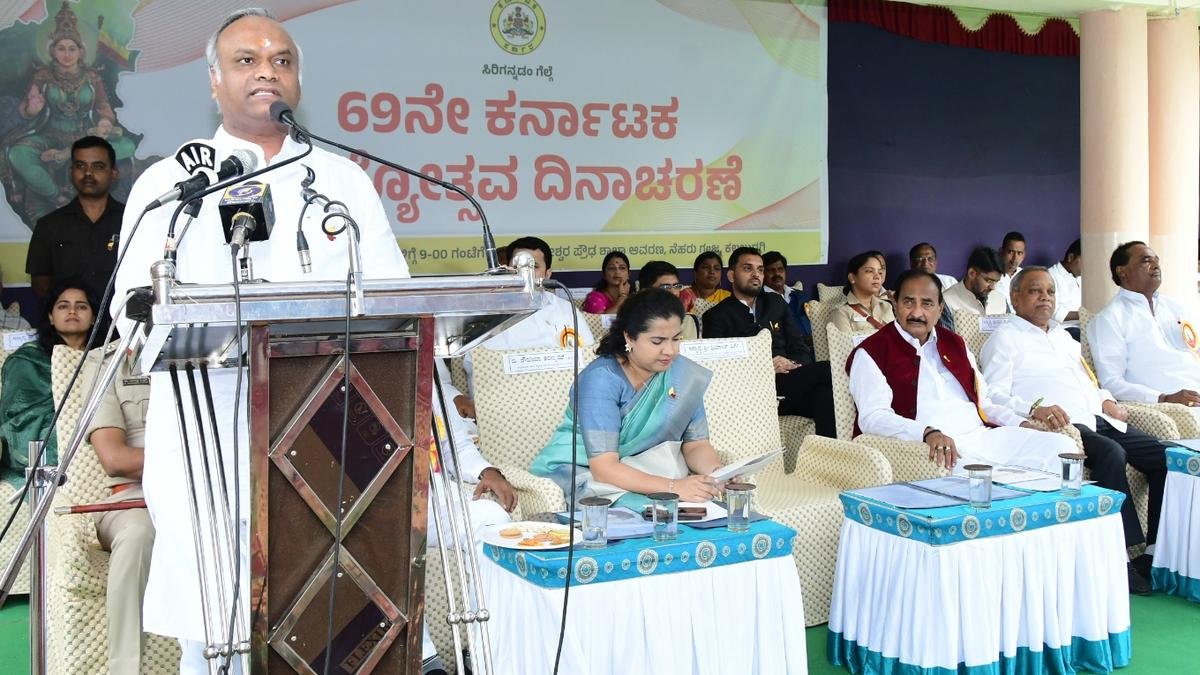

Rural Development and Panchayat Raj Minister and district in-charge Priyank Kharge speaking at the 69th Rajyotsava celebrations on Nagareshwar School premises in Kalaburagi on Friday.
| Photo Credit: ARUN KULKARNI
Elaborating on the alleged financial injustice being meted out to the State by the Union government in the devolution of taxes, Rural Development and Panchayat Raj Minister and Kalaburagi in-charge Priyank Kharge has stressed the need for a sustained and widespread movement for a “just” share in tax collection.
“Karnataka is a land of social movements. Whenever we were ‘discriminated against’, we fought back to reclaim our rights. It is evident right from the 12th-century social revolution led by Basavanna to the recent agitation for Article 371(J). We must launch a similar movement to fight back against the ‘injustice’ and ‘stepmotherly treatment’ by the Union government. Karnataka must send a clear message that, in a federal system, all States must be treated fairly and equally for the development of the country,” Mr. Kharge said, after hoisting the national flag to mark the 69th Rajyotsava celebrations on Nagareshwar School premises in Kalaburagi on Friday.
Mr. Kharge spoke on how the Union government “continues to diminish Karnataka’s share in tax devolution during the last four Financial Commissions to incur a loss of ₹78,000 crore”.
“Karnataka’s share decreased from 21.1% in the 11th Finance Commission to 15.8% in the 15th Finance Commission. The drop of 5.3% means a loss of ₹78,000 crore. While the share of the State in tax devolution has seen a steep drop, the share of States such as Uttar Pradesh, Bihar and Madhya Pradesh in tax distribution has seen a phenomenal rise,” Mr. Kharge claimed.
On the Union government’s alleged financial discrimination against Karnataka, Mr. Kharge said that the State managed 72% of its expenditure from its own resources whereas Bihar’s 77% expenditure is managed with Union government’s funds.
“Karnataka gets back only ₹12 for every ₹100 it contributes in the form of tax. However, Uttar Pradesh gets ₹333, Madhya Pradesh ₹297, Bihar ₹922 and Odisha ₹Rs. 187 for every ₹100 they contribute to the national tax kitty. This is how Karnataka is being meted out ‘financial injustice’. We must raise our voices against this ‘injustice’ by the Union government,” Mr. Kharge said.
Speaking on Karnataka’s contribution to the country’s economy, Mr. Kharge said that the State is the second biggest in the country in terms of Goods and Services Tax collection and Foreign Direct Investments.
“Karnataka is in the fourth position in start-up development. It is in the second position in Foreign Direct Investments with a 32% share. Information Technology exports crossed ₹4.5 lakh crore last year and all the revenues go to the Union government and Karnataka has ‘got nothing’ from it. Karnataka has a 40% share in the electronic designs market, 52% in machine and tools manufacturing, 65% in aerospace and defence manufacturing, 60% in biotechnology exports and 21% in the national bio-economy. Karnataka is a leading state in Artificial Intelligence development. It is the skill capital of India,” Mr. Kharge said.
Delimitation
Opposing the proposed delimitation of Lok Sabha constituencies in accordance with population, Mr. Kharge said that such a move will make States such as Karnataka, Tamil Nadu, Kerala, Andhra Pradesh and Telangana irrelevant in Parliament as the other States will have more numerical strength.
“If the proposed delimitation of Lok Sabha constituencies is done, the number of Lok Sabha seats will be increased from 543 to 846. It will give 193 additional seats to States in the north of India as compared to 23 additional seats to those in the south. The number of Lok Sabha seats will come down from 28 to 24 in Karnataka, from 25 to 20 in Andhra Pradesh, from 39 to 30 in Tamil Nadu, from 20 to 14 in Kerala and from 17 to 15 in Telangana. The number of Lok Sabha seats in Uttar Pradesh, Bihar, Madhya Pradesh and Rajasthan will increase from 174 to 294. In essence, those States will dominate in Parliament and that numerical strength will influence national policies,” Mr. Kharge said.
Published – November 01, 2024 07:49 pm IST


