
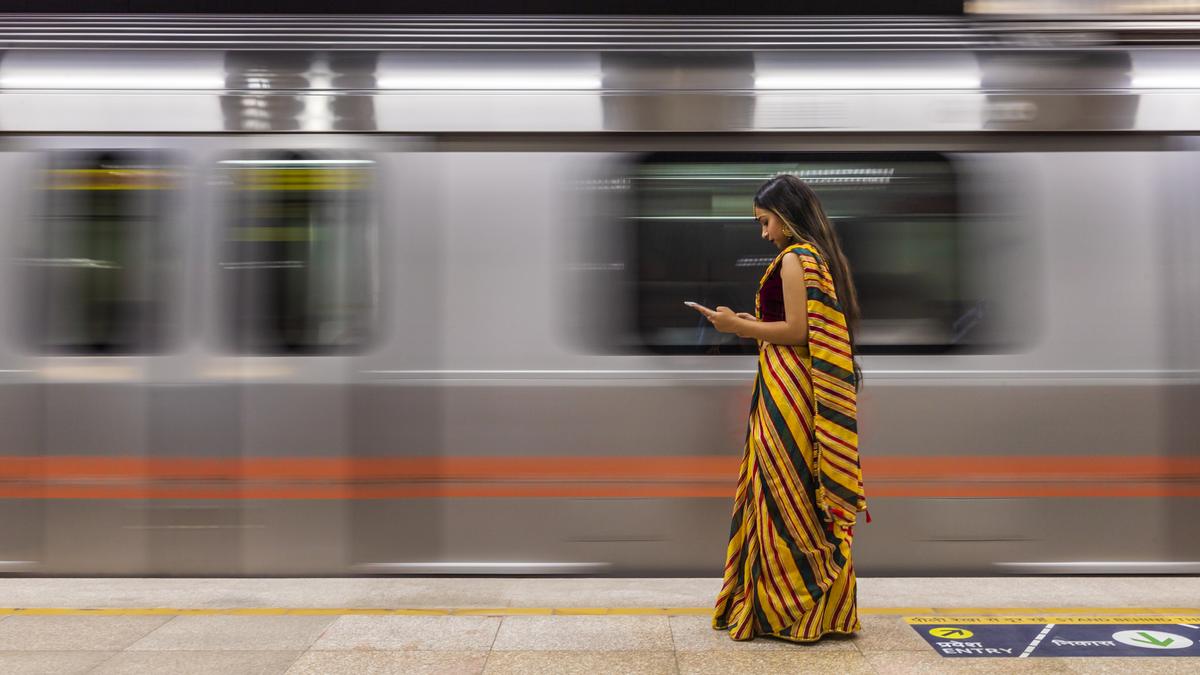
Mobility should be a choice, but when public transport or mobile networks are inadequate or absent, they can heighten risks of violence and restrict access to public places.
| Photo Credit: Getty Images
Space is constituted and constructed by the social interactions within society. Space is actively used in determining and maintaining social power relations such as gender, class, and ethnicity. Henry Lefebvre has said that space is not only a “neutral container waiting to be filled, but is a dynamic, humanly constructed means of control, and hence a domination of power”. The Sustainable Development Goal 11.7 mandates that by 2030, countries need to “provide universal access to safe, inclusive and accessible, green and public spaces, in particular for women and children, older persons and persons with disabilities”.
Women make constant efforts to negotiate unsafe conditions in public spaces through avoidance, protection, and prevention. It was only through a “concerted social struggle, demanding the right to be seen, to be heard, and to directly influence the state and society” that women gained access to public spaces.
For a majority of women to step out, an outright purpose needs to be there. Defining the “narrative of safety”, the authors of the book Why Loiter? write: “All the ideas that people have, the stories they tell, and the beliefs they hold about safety eventually become part of the popular public imagination.” Studies report that the fear and risk of harassment compels women to defend their safety while accessing public spaces. This further prompt behavioural changes preventing women from fully participating in social and economic opportunities.
The gendering of space is distinctively notable between public and private, in which the public domain is perceived as male space and the private as female space. This is largely because of the social construct of respectability but also because of a restriction of movement due to “the threat of male violence”. Traditionally, spaces are imagined as women’s bodies. In 1865, for example, the anthropologist Karl Schmidt wrote, “The man appears as time incarnate, the incarnate process of becoming; woman as space, as being. Activity and passivity, mind and body, brain and heart, head, and belly, individual and species, positive and negative pole: man and woman.”
Sanjukta Basu writes, “Women are allowed to venture out in public space, but not really own it.” As public transport, the Metro is also a moving picture of social relationships. To prevent violence against women, safe spaces have been established all over Indian cities. Prominent example is the implementation of women’s compartments in the Delhi Metro. This compartmentalisation of the Metro may seem like another form of limiting women’s movement and enforcing patriarchal structures/paternalism. In the book The Moving City, Rashmi Sadana notes that the safety discourse teaches women from a young age that it is their fault if anything happens to them and that they need male protectors and guardians to get through life and public spaces.
As Michel Foucault showed in exemplary fashion, the constraining, almost compulsive gaze men cast at female bodies is always bound up in a complex of power and knowledge. Urban spaces do provide women, especially migrant women, with anonymity, which allows them to escape the patriarchal holds of family and community. Thus, spaces must be seen as orderings/arrangements that are inherently dynamic but also contested.
In her study on gender in the early modern age, Bettina Mathes stresses that “it is in the gaze that gender is constituted”. In the context of Delhi, fear is the predominant emotion used to entrench social, political, and institutional discourses and practices of control over women’s engagement with the city.
Women experience cities differently from men, majority of times women are hyper-aware of male strangers or decide not to go out at all. Mobility should be a choice, but when public transport or mobile networks are inadequate or absent, they can heighten risks of violence and restrict access to public places. This reinforces gender power relationships which consequently disempowers women.
The fact that we see fewer women driving autorickshaw and cabs or working as delivery agents reflects the way women are not able to access public spaces freely due to both devastating realities and heightened perceptions of crime, shaping their choices in daily activities. This highlights the urgent need to address safety concerns, challenge societal norms, and create environments that prioritize women’s security, enabling them to participate fully in various aspects of public life.
ishikachaudhary23g@gmail.com
Published – October 27, 2024 02:12 am IST


